

What Is Flexibility?

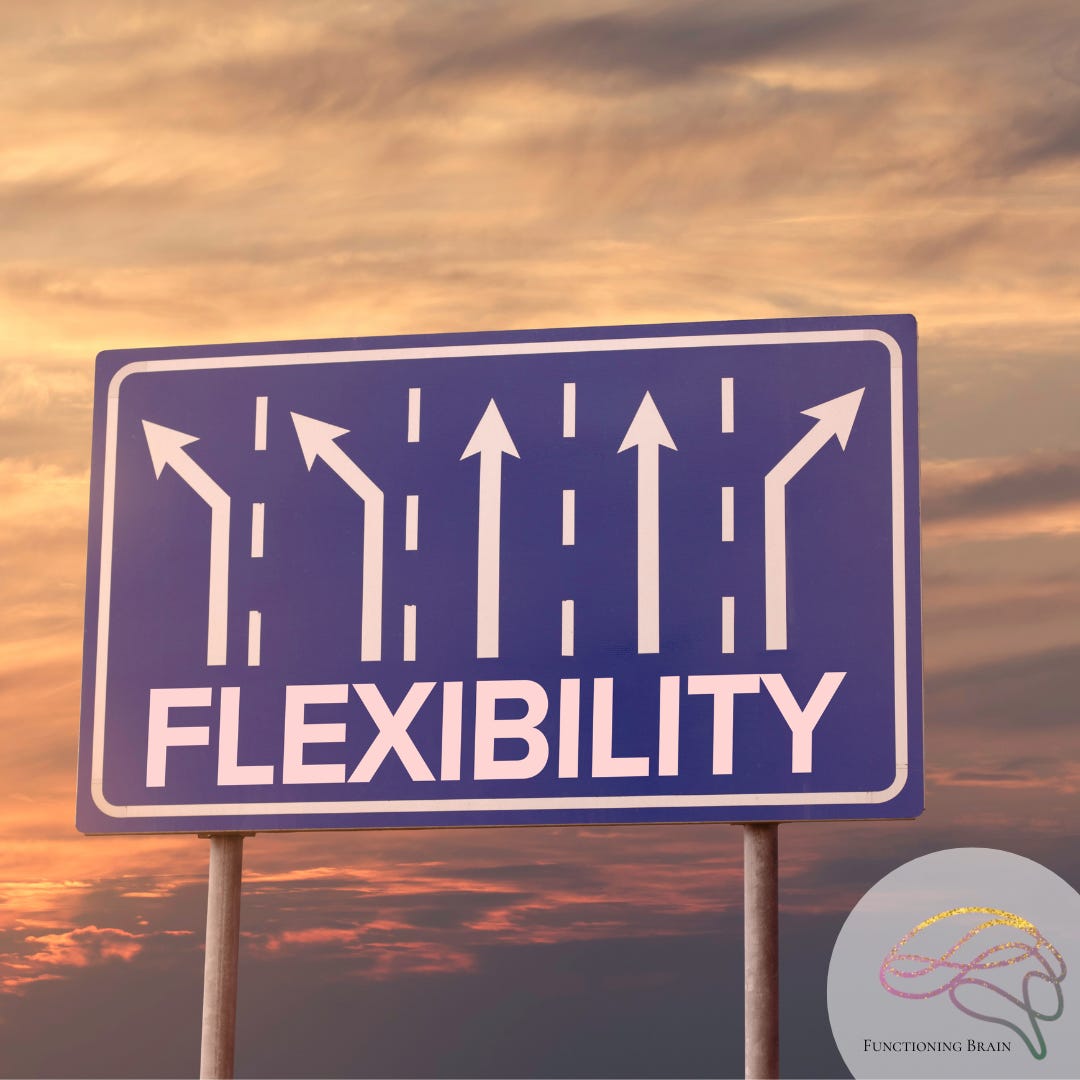
Let’s talk about a skill that quietly shapes so many part of a child’s day:
Flexibility.
Not the gymnastic kind.
The executive functioning kind — the brain-based ability to adjust, shift, and adapt when the world doesn’t go as planned.
Let’s be clear - adults don’t love being flexible. And sometimes the demand is more than we can handle.
Now pretend you are a kid, who hasn’t fully developed the skill yet?
So, what is flexibility?
Flexibility is the brain’s ability to move from “stuck” to “shift.” It’s what helps us revise an idea when new information appears, change course when the plan suddenly falls apart, and try again when the first attempt doesn’t work.
Flexibility allows children to take in what’s happening and adjust their thoughts, behavior, or expectations — ideally without melting down or shutting down.
It shows up when a child realizes, “This isn’t working; I’m going to try something different.”
Or when a long-awaited hike gets rained out and they can think, “Okay… what can we do instead?”
Or when someone doesn’t understand their explanation, and they rephrase it instead of repeating the same sentence louder.
In simple terms: flexibility helps the brain pivot instead of freeze... or catch on fire.
Why does the brain need flexibility?
Flexible thinking is the brain’s internal “gear shifter.” Life hands us constant transitions — from home to school, from preferred activities to required ones, from one set of expectations to another.
When a child is flexible, they can move between these shifts with less emotional friction. They can regulate their reactions when the plan changes, switch tasks without feeling overwhelmed, and update their thinking as new information comes in.
When flexibility is still developing (which is true for most kids), even small changes can feel massive. A detour in routine, a correction in math, a friend offering a different idea, or a sudden transition can feel like their entire system has been knocked off balance.
What adults see as “overreacting” is often the brain struggling to shift gears.
What flexibility is not
Flexibility often gets misunderstood, so it’s helpful to clear up a few misconceptions.
It’s not impulsivity — acting quickly or randomly isn’t flexibility; that’s simply reacting.
It’s not inconsistency — bouncing between decisions every few minutes is dysregulation, not adaptability.
And it’s definitely not “giving in” — accepting a change after crying, panicking, or shutting down doesn’t mean a child was flexible; it means they were overwhelmed.
True flexibility comes from a place of calm awareness, not chaos.
It’s thoughtful, not frantic.
It’s a choice, not a collapse.
What flexibility looks like in everyday life
You’ve seen these moments:
a kid who gracefully accepts that a picnic needs to turn into an indoor lunch
a student who tries a second math strategy after realizing the first one wasn’t getting them anywhere
a child who can adjust when a game rule changes mid-play
a child who notices their friend isn’t understanding and naturally tries a new way of explaining something.
We often forget how many tiny adjustments make up an average day. Each shift — each pause, each new attempt, each pivot — is flexibility in action. And each of those moments builds resilience.
How flexibility develops
Flexibility isn’t an all-or-nothing skill. It unfolds over years, beginning with small shifts in early childhood and becoming increasingly complex through adolescence. Little ones start by managing simple changes in routine. Think of the toddler who can be frustrated, stomps their foot, and goes with the new plan.
School-age children begin switching strategies and noticing different perspectives. They start to build friendships based on more than just having the same favorite color.
Teens develop the capacity to revise their plans, rethink their beliefs, and adapt more independently.
And yes — this developmental path is slow. Kids aren’t “behind” because they struggle with change at 7 or 12 or even 17.
Remember: their prefrontal cortex is still building these pathways well into adulthood.
A quick look at the brain science
When we ask a child to be flexible, we’re asking their brain to do several things at once:
inhibit an old idea
update new information
shift their attention
regulate their emotions
generate a new plan
That’s a lot.
No wonder transitions can be hard.
No wonder changes can feel enormous.
This is why flexibility is one of the last executive functioning skills to fully develop.
Why flexibility matters long-term
Flexibility is the foundation of problem-solving, creativity, emotional resilience, and perspective taking. It helps kids cope with change without falling apart. It allows them to revise their plans, connect better with peers, navigate setbacks, and respond to challenges with more ease. Adults with strong flexibility navigate work stress, shifting expectations, and unpredictable life events far more smoothly.
On the other hand, when flexibility is still developing, we often see repeated mistakes, arguing the same point over and over, resistance to schedule changes, difficulty switching tasks, frustration when routines shift, or meltdowns during transitions. Not because a child is stubborn, but because their brain simply cannot shift yet.
Flexibility isn’t a personality trait. It’s a developing brain skill — and one we can support, nurture, and strengthen over time.
Bottom Line
Flexibility is the quiet skill that helps kids adapt when the world doesn’t match the picture in their mind. It’s not about liking change or being “easygoing.” It’s about learning to navigate the unexpected without losing their center.
This week, start by noticing where your child gets stuck — and where they shift more easily than you expected. Both moments offer clues about their developing brain, and about what support they need next.
Warmly,
Tara Roehl, MS, CCC-SLP 💛
P.S. Paid subscribers — tomorrow’s post will share practical, brain-friendly ways to assess flexibility at home!