

Mindful Monday: Working Memory (Part 4)
When the Brain Says “You’ve Got This!”… But It Doesn’t

We’ve talked a lot about working memory being the brain’s “waiting room”—a place where it temporarily holds information it needs to use.
We’ve also discussed how long that information hangs out in the waiting room.
This week, we’re diving into more of what it looks like when working memory isn’t working well—and why so many kids (and adults!) struggle silently until everything seems to “suddenly” fall apart.
Spoiler alert: it’s not sudden. And it’s not their fault.
It’s frustrating—for them and for you.
But it’s also a distress signal, a white flag flying.
Not defiance. Not laziness. Not disinterest.
Just a brain working really hard and still coming up short.
The Smart Kids Who Can’t Remember Their Homework
I once worked with a high schooler who knew everything about sports stats. He could rattle off player data, draft predictions, season averages—he was a walking ESPN.
But he couldn’t tell me if he had homework.
He’d leave class with no memory of assignments. But often, the moment he stepped back into the classroom the next day, he’d go, “Oh! I forgot I had that worksheet!”
Why?
Because the classroom itself was a visual trigger. That environment jogged his memory. But when he left class without any cues—no notebook reminder, no sticky note, no visual to hold onto—his brain interpreted that as “Nothing important here.”
That’s how slippery working memory can be.
The Brain’s Empty Promises
I tell my clients all the time:
“Don’t trust your brain. It’s a punk. It swears it’ll remember. But it’s lying.”
Sound harsh? Maybe a little. But it’s science-based honesty.
Your brain has about 20 seconds to hold onto something unless you’re doing something active to keep it there—repeating it, visualizing it, or writing it down. Otherwise? It’s gone. Not because you’re careless, but because that’s how the system works.
When we teach our kids not to trust their brains blindly—and instead, give them tools to support memory—we build resilience and realistic self-awareness.
Visual Triggers: The Game-Changer
When I worked in a clinic that didn’t allow executive functioning intervention (yep, really), I had to get creative.
I started weaving executive functioning support into gamification.
Each group had a “team” and earned points for participation, homework, and teamwork. I sent home printed scorecards—these were visual triggers at home. And in the hallway? A giant scoreboard tracked everyone’s progress.
It wasn’t just fun. It worked.
Kids who used to resist coming into the clinic would now race in to check their team’s status. They collaborated. They remembered their homework. They strategized together.
They were practicing executive functioning skills—and building working memory.
Why did it work?
Because I gave them a visual trigger. Something their brains could hold onto, even outside of the moment.
And I bypassed that tricky fight-flight-freeze response, because they were playing.
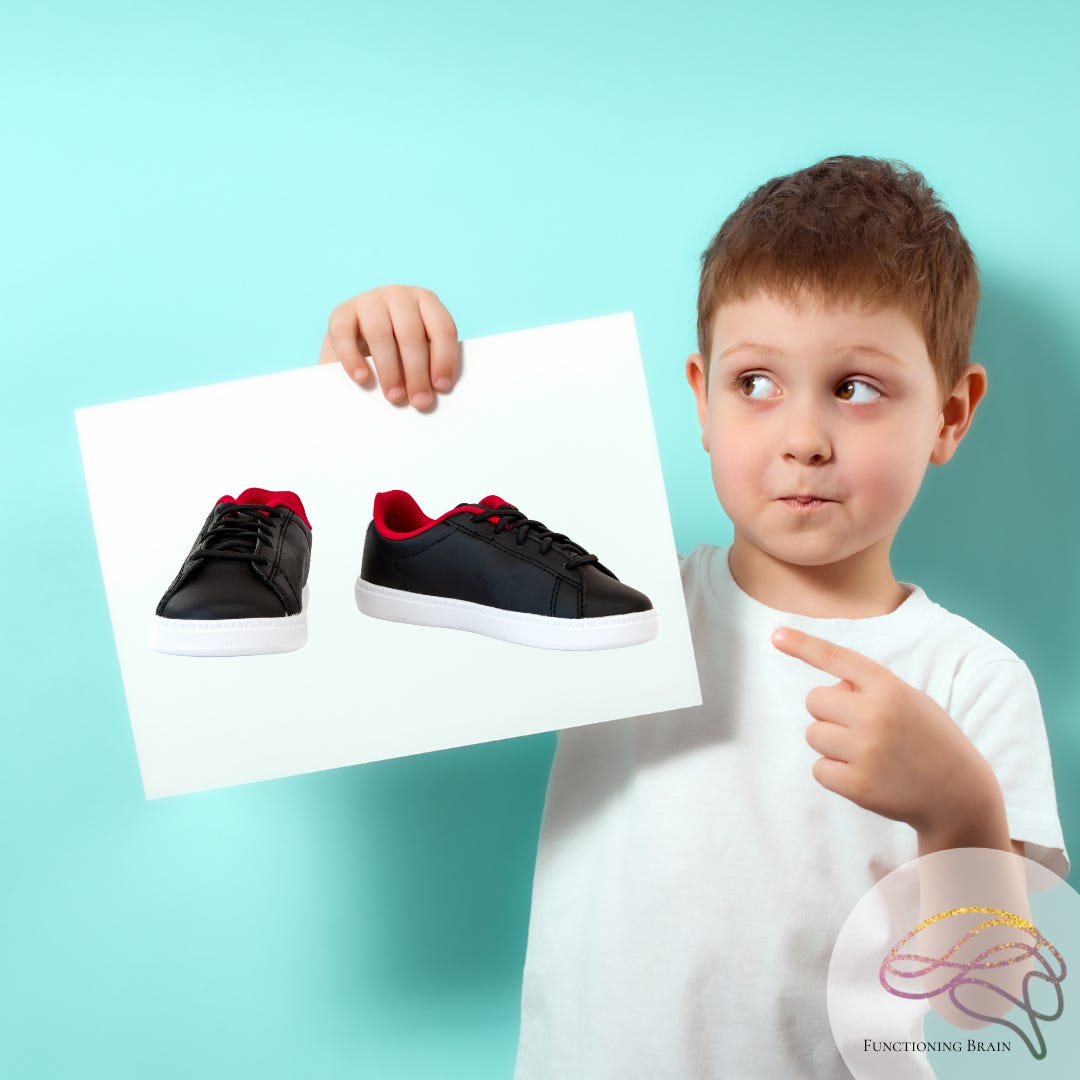
What Is a Visual Trigger?
A visual trigger is anything the brain can associate with information it needs to remember.
It could be:
A doodle on a sticky note.
A colored circle on a door frame.
A picture of the object they need or the task they should be performing.
A physical object:
Socks when they are headed to get shoes
A cup when they need to set the table
Their toothbrush to head to the bathroom at bedtime
Eventually, those external triggers become mental pictures, helping the brain build internal strategies like visualization and chunking—two major working memory tools.
We’re teaching the brain to create its own memory supports.
When Smart Isn’t Enough: The Hidden Cost of Compensation
One of the hardest parts of supporting kids with working memory challenges?
They can “fake it” really well for a really long time.
I’ve worked with so many brilliant, creative, amazing kids—kids who charm adults, kick butt at trivia night, and can talk for hours about their favorite topics with passion.
But behind all that brilliance, there’s often something else: a quiet struggle to keep up with the everyday mental load of school, social situations, and life.
They use their intelligence to compensate.
They memorize routines instead of truly understanding instructions.
They guess what the adult wants and aim to deliver just enough. Becoming hyperaware of changing emotions and nonverbal cues.
They avoid tasks that require juggling too much mental load —often with clever excuses or subtle deflection.
They lean hard on pattern recognition and context clues to give the illusion that they’re following along with everyone else.
And for a while? It works.
The adults around them may not even notice. Grades stay passable. Behaviors fly under the radar. Everyone thinks, “They’re doing great.”
But here’s the problem:
Compensation isn’t comprehension.
And it’s not sustainable.
As demands increase—academically, socially, emotionally—those patched-together strategies start to fray.
Suddenly, multi-step directions are seemingly impossible.
Assignments are missing, half-done, or forgotten entirely.
The child who used to seem so capable is now overwhelmed, frustrated, even shutting down.
It looks sudden. Like something broke.
But it’s not sudden. It’s more like when a dust storm blows so strong it reveals a hidden artifact.
This time it’s the slow erosion of an overloaded system.
A system that’s been white-knuckling its way through, doing its best without the actual skills it needed.
This is where so many of the kids I work with get misread.
They’re told they’re lazy. Not trying. Being irresponsible. Puberty kicked in and now “they just don’t care”.
But what’s really happening?
They’ve reached the limits of what their working memory can carry alone.
And they don’t have any idea of what to do next.
That’s why our job isn’t just to notice when a they start to fall behind, it’s also to start asking “why” - with compassion and grace.
Because they’ve been doing a lot of hidden work. And we all know how it feels to be working “behind the scenes” and then being told we aren’t doing enough.
They need real tools, safe support, and someone who sees how hard they’ve already been trying.
And you’re here, working to see them, and understand them.
That is incredibly important work.
What Can You Do?
Watch for the signs:
Meltdowns over “easy” tasks
Forgetting things they’ve “just” learned
Seeming smart but inconsistent
Avoiding schoolwork or asking for help
Becoming overwhelmed by tasks that require multiple steps or transitions
Then support them—not with punishment or more pressure—but with strategies and tools.
And above all: grace.
The Heart of the Matter
Your child is not broken.
They don’t need fixing. They need understanding, scaffolding, and strategy.
They need to know their brain is doing the best it can—and that they aren’t “bad” at school, they just haven’t been given the right tools yet.
The word “yet” holds so much possibility!
Every time you slow down to help them write something down…
Every time you co-create a visual routine…
Every time you tell them, “Let’s figure out how your brain works best…”
You’re building a life where they don’t have to fake it anymore.
They can thrive—authentically, confidently, and with clarity.
Next Week, We Talk More Research
So now that we’ve seen what working memory struggles look like…
Next week, we’ll talk more about what the research is uncovering.
Because there are so many things we haven’t learned about the brain…
Yet.
You’ve got this. You’re doing the work of connection and cognition every day.
And I’m cheering you on every step of the way. 💛
Warmly,
Tara Roehl, MS, CCC-SLP