

Mindful Monday: What Does “Organization” Really Mean?

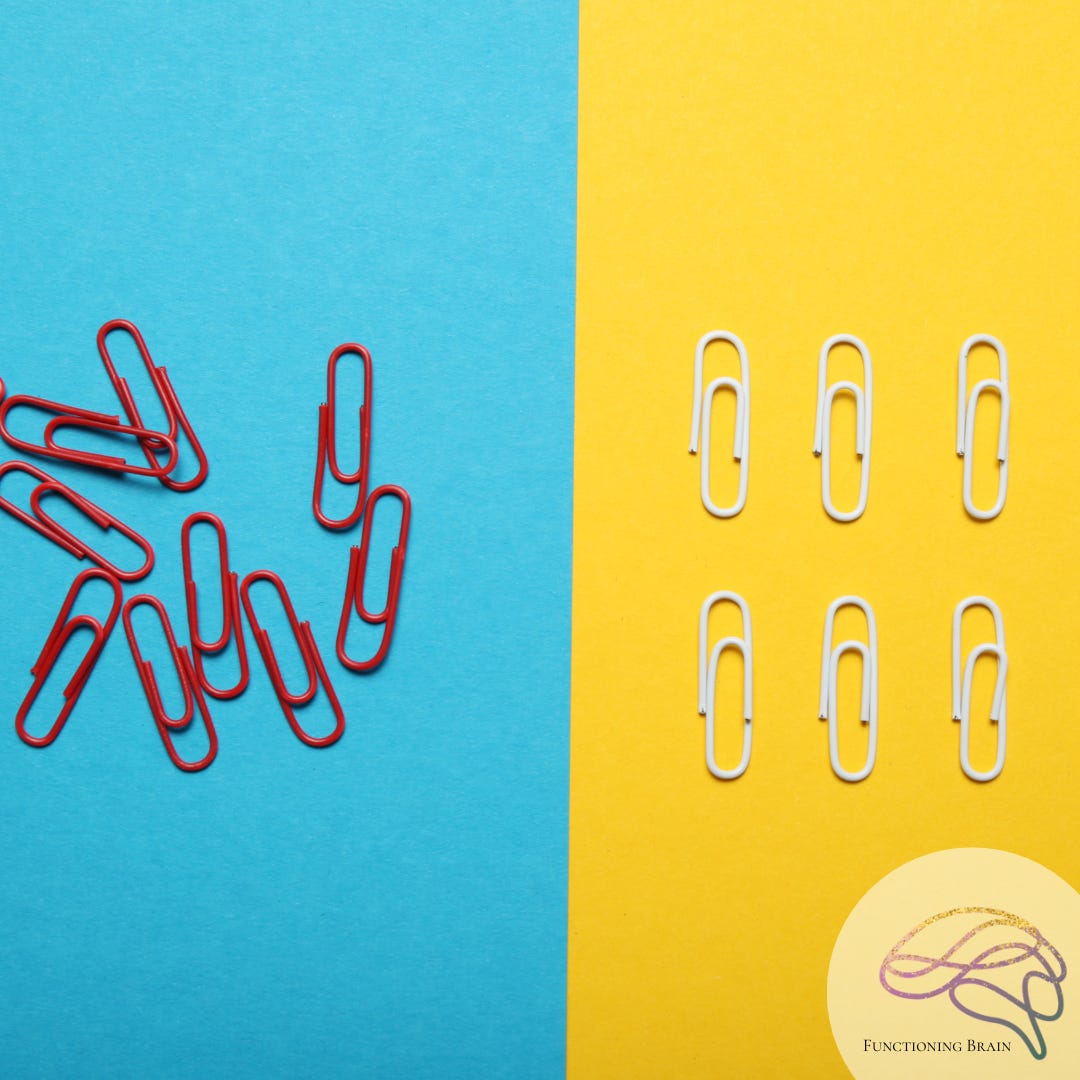
When you hear the word organization, what do you think of? Maybe you picture a bookshelf organized in rainbow-colored order, or a pantry full of glass jars with matching labels. Maybe you think of calendars and planners, or a color-coded wall chart that keeps your family schedule running.
Those are all part of organization—but let’s take a deeper view.
Organization isn’t just about tidy spaces. It’s about order—the invisible structures that help us move through the world. It’s the way a waiting room is laid out, the sequence of steps in a routine, the rhythm of a day, the way we arrange our stuff so it works for us, and even how we position ourselves in relation to other people.
Some people’s brains notice and process this instantly. They walk into a space, scan it quickly, and know how to move and where to sit. They take a new task and mentally sort it into steps. They can see clutter and know which pile doesn’t belong. Their brains naturally lock into the order of things.
But for many kids (and adults) who are still developing executive functioning skills, this doesn’t happen automatically.
And that gap shows up in big and small ways.
Seeing Organization in the World
Let’s take a very ordinary example: walking into a new doctor’s office waiting room.
One brain might instantly sweep left to right and think:
Reception desk up front.
Seating over here.
Those doors must be where the doctors call patients.
That scan happens so quickly that most people don’t even notice they did it. They’ve organized the space and figured out the key areas.
Now imagine a child—or an adult—whose brain doesn’t do that automatically. They walk in and instead of mapping the layout, they’re still processing the flood of sensory details: the buzzing lights, the chairs in all different colors, the sound of papers rustling, the smell of sanitizer and that blaring TV. They may wander or stand awkwardly in the middle. They may sit too close to someone else without realizing it.
Not because they don’t care, but because their brain isn’t automatically seeing the order of the room.
And too often, the world responds by saying, “Stop being weird,” or “Chill out,” instead of realizing: this is an executive functioning skill gap.
Clean vs. Messy: The Room Example
This also shows up in the classic “clean your room” battle.
Parents walk in, see chaos, and say: Clean this up.
The child hears the words but doesn’t see what you see. Maybe they pick up a few things, shuffle piles, move dirty socks from the floor to the desk, and then proudly announce: It’s clean!
You walk back in and think: Are you kidding me? It’s still a disaster.
But in their brain, they made progress. The socks are no longer on the floor. To them, that’s a real shift. They just don’t have the mental picture of what “clean” means to you. They’re moving things around from one version of chaos to a different version of chaos - trying to guess at your goal.
Sometimes their system even makes sense—to them. Take the kid who put all their clean underwear on their desk. Why? Because every morning, they placed their book on the desk before school. If their underwear was there too, they wouldn’t forget to put it on, and then no one would yell at them for forgetting.
Logical? Yes.
Socially acceptable? Not so much.
This is organization at work—but through their lens and without all their executive functioning skills at play. The system worked for the immediate problem (not forgetting underwear). It just didn’t account for the bigger picture: “Where will I do homework if my desk is full of clothes?” or “What will my friends think if they see this?”
Working Within Organization
Seeing organization is only the first step. Once you’ve noticed the order of a space or task, your brain then has to figure out how to work within it.
Think about waiting rooms again. It’s not enough to notice the reception desk. You also have to figure out:
How do I check-in? How close do I stand?
When do I sit down? Not too close to that coughing guy…
Where will they call me back from? Can I hear them over that TV? Wait, is that the soap opera my grandma used to watch?!
These are subtle social and spatial rules that most people learn automatically.
For kids who don’t process this naturally, it can feel like a constant game of “catch-up.” They might stand too close in line. They might block the doorway without realizing it. They might place themselves in ways that others find “odd.” And unfortunately, instead of recognizing the underlying skill gap, the feedback they often get is “Just act normal.”
But what’s “normal” when your brain doesn’t automatically see the system?
Creating Their Own Systems
Sometimes kids respond by creating their own systems.
Like the underwear-on-the-desk example, their system solves the immediate problem—but doesn’t always account for long-term or social factors. Another child might stash all their school papers on the living room end table, because that way they’ll see them during TV time and won’t forget homework.
It works for their brain in the moment. But then the papers get crumpled, slide behind the couch, or mixed with the magazines and tossed.
When we dismiss these attempts as “wrong” or “lazy,” we miss an opportunity. Because what they’re actually showing us is that they want organization. They’re trying. Their brain is reaching for a system—it just might not be the system we had in mind.
Why This Matters
Organization is not a “nice-to-have.” It’s foundational.
It’s how we know where to sit in a waiting room.
It’s how we figure out the order of steps for brushing our teeth.
It’s how we learn that a clean room isn’t just “stuff moved around” but “things put in places where they belong.”
It’s how we navigate social rules, daily routines, and eventually workplaces and relationships.
When kids struggle with organization, it doesn’t just mean their room is messy. It can mean:
Feeling out of place in social spaces.
Constant frustration when their systems don’t “match” ours.
Missing deadlines or forgetting steps because the order wasn’t clear.
Exhaustion from constantly trying to guess what’s expected.
This isn’t laziness. This isn’t defiance. This is an executive functioning challenge.
Where We Go From Here
The good news is that organization can be taught, modeled, and scaffolded. Just like time awareness, it’s a muscle that can grow with practice.
Because at the end of the day, our goal isn’t to force our kids into Pinterest-perfect organization. It’s to help them develop the skills to navigate spaces, tasks, and relationships with more confidence and less stress.
Organization is a complex, lifelong skill. And every small step your child takes—whether it’s noticing the reception desk, creating a quirky system, or moving one more pile off their floor—is progress.
Celebrate that progress.
Meet them where they are.
And keep building, one layer at a time.
Warmly,
Tara Roehl, MS, CCC-SLP 💛
P.S. Paid subscribers—Tomorrow, in Tuesday Tips, we’ll talk about some gentle ways to “test” how much your child sees organization in their daily spaces. These activities can give you a peek inside their brain and help you understand their perspective. From there, we can start building strategies that bridge the gap—helping them see, practice, and eventually create systems that work both for them and in the wider world.