

Mindful Monday: Planning ≠ Organizing (and Other Misconceptions)

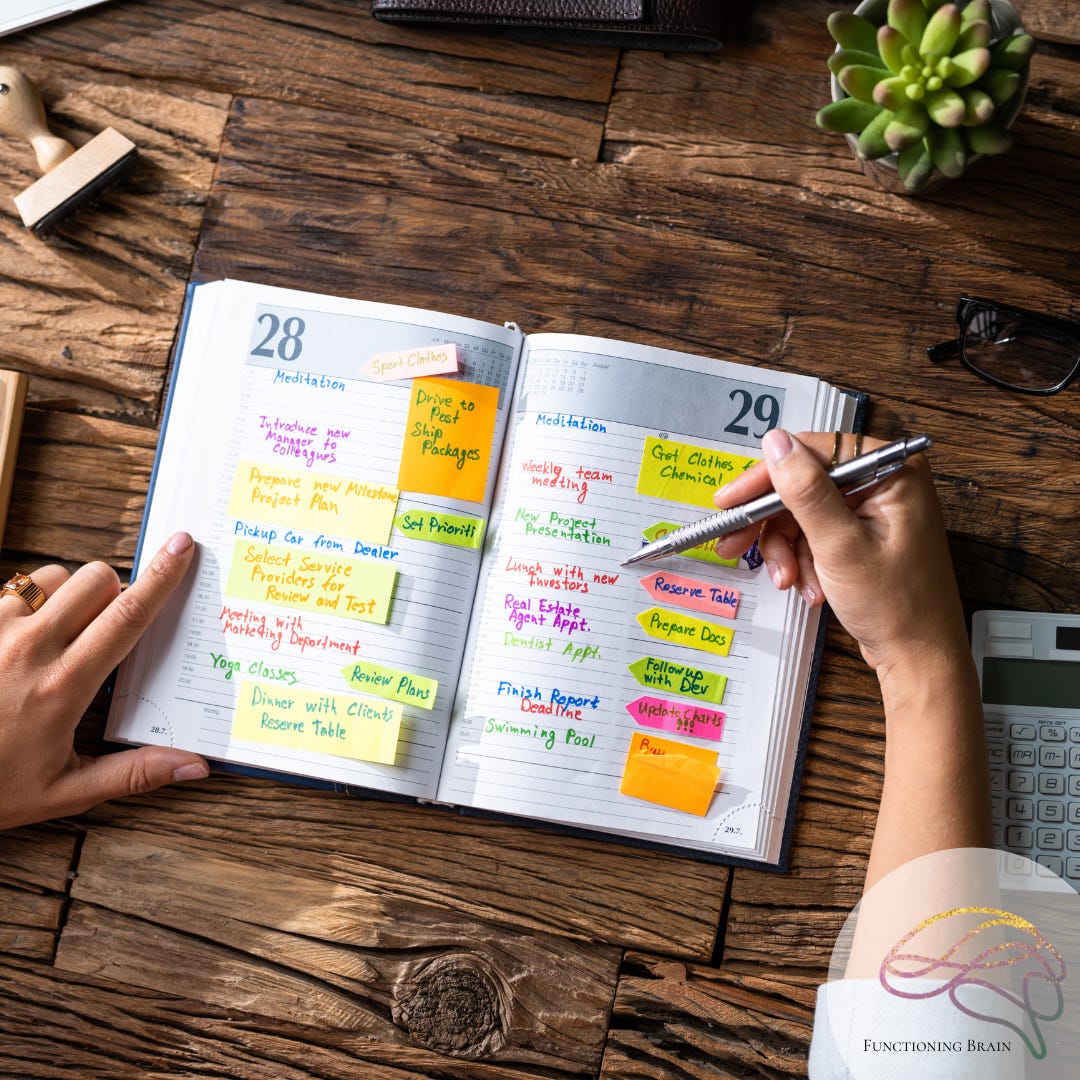
We’re kicking off a brand-new six-week series on Planning and Organization—two very misunderstood executive functioning skills.
People often use the terms interchangeably, assuming if you’re “organized” you must be a great planner, or if you can “plan” you must also be organized. But the truth is: they’re related and overlap, but definitely are not the same thing. And like any other executive functioning skill, each can be strong or weak independently.
Even more importantly: being able to plan or organize doesn’t automatically mean you’re using executive functioning efficiently, calmly, or confidently.
Some people (maybe even you!) only get things done when worry, panic, or anxiety kick in. That adrenaline-fueled “fight/flight” response can push a procrastinator to finish an A+ essay at 2 a.m. or pull together a presentation right before stepping in front of a crowd.
Yes—it works. But it’s not sustainable. Strong planning and organizing skills mean you can do it without needing a crisis to kickstart the process.
So today, let’s zoom in on planning—what it really is, and the myths that often hold us back.
[Don’t worry, in the weeks to come we will chat all things organization, too!]
What Is Planning, Really?
Psychologist A. R. Luria (1978) described planning as the ability to organize behavior in relation to a specific goal that must be achieved through a series of intermediate steps. Put simply: it’s forecasting what needs to happen, breaking it down into smaller parts, and choosing a path forward.
And that complexity means planning is not one skill. It’s actually a bunch of skills:
Prioritizing what matters most.
Sequencing steps in the right order.
Estimating how long tasks will take.
Anticipating obstacles and problem-solving around them.
Shifting gears when things change.
Maintaining the end goal in mind and continue to work towards that end.
Common Misconceptions About Planning
Here are some of the biggest myths I’ve read and heard first hand:
Kids know what “planning” means
Adults often say, “Make a plan” without ever teaching what that looks like. Many children don’t actually know the steps involved in planning, so the request is vague or even impossible.Adults shouldn’t help too much
Independence doesn’t appear overnight. Kids need scaffolding, co-planning, and lots of practice alongside supportive adults. Gradually, responsibility can shift as their skills grow. Expecting them to learn through repeatedly failing isn’t sustainable.Planning ability = maturity level
Executive functioning skills don’t always match chronological age. A teenager may still plan like a much younger child, and that can actually be developmentally normal. The brain builds these pathways gradually and in different order depending on the demands of their life.Poor planning = laziness
This is one of the most damaging misconceptions. Struggles with planning aren’t a matter of willpower or effort—they’re a sign of a skill gap that needs support and practice. It’s an opportunity to take a moment and build skills together for the future!Kids don’t plan because they don’t care
Most of the time, kids do care—they just lack the skills. What looks like avoidance is often frustration or overwhelm. Would you want to keep trying at something you don’t understand and keep getting in trouble for doing poorly?If a child can plan a game, they can plan schoolwork
Motivation plays a huge role. Kids may find it easy to plan a strategy for a game or activities for a playdate, but those skills don’t automatically transfer to less preferred tasks like homework. That leap needs guided practice and sometimes explicitly making connections.Good planning is automatic
No one is born knowing how to break big tasks into smaller ones. It’s a learned skill. Sure, some kids can watch others and figure it out. But most people actually benefit from being explicitly taught, modeled, and practiced over time.Planning is one skill
Planning is actually a cluster of executive functioning skills—time management, prioritization, working memory, flexibility, and more. If one piece is weak, the whole process is affected.Planning is the same as organizing
Organizing is about tidying materials or arranging information. Planning is about forecasting, decision-making, and sequencing steps. They overlap, but they’re not the same skillset. They are connected within the realm of executive functioning because of their strong overlap. But I specifically mention them individually as well, to show they both need recognition!Planning takes less time than doing
For many children with executive functioning difficulties, planning can actually take longer than the task itself. That doesn’t mean it’s wasted time—slow, careful planning builds stronger habits in the long run.Planning = Writing it down
Just because a child can write something on paper doesn’t mean they understand it or can actually carry it out. Many of my clients have been great at “copywork”. The real work is in internalizing the plan, holding it in working memory, and acting on it step by step.Planners and calendars solve the problem
Tools don’t teach skills. Many children abandon planners quickly because nobody showed them how to break down tasks, use reminders, or revise their plans. The tool only works when scaffolding is in place. And if their working memory is still building? They often forget the planner even exists!Planning = making a list
Lists are helpful, but they don’t teach prioritization, estimating how long tasks take, or how to pivot when something unexpected happens. A list without strategy can lead to even more overwhelm.Planning means knowing what to do first
It’s not just the “first step.” Good planning involves sequencing all the steps, predicting time needs, and identifying what materials or resources are required. Real planning actually involves knowing what comes at the end, first!Planning is linear
Real planning is messy. It involves circling back, revising, adjusting, and starting over. Step 1 → Step 2 → Step 3 looks tidy on paper, but brains don’t work that way in real life.Planning only matters for big projects
Daily life is filled with “micro-plans”: getting dressed, packing a backpack, preparing lunch. Helping kids recognize and practice small planning moments builds confidence for the bigger ones.A plan will always work if you follow it
Even the best plan will need tweaks. Real life throws curveballs, and flexibility is just as important as structure. Learning to adapt is part of the process.Good planning = neatness
A tidy planner isn’t the same thing as an effective plan. Some kids think and work in messy or unconventional ways that still “work” for them—and that’s okay.If you can plan once, you can always plan
Children with executive functioning difficulties often show inconsistency. They might successfully make a plan one day, then struggle the next. That doesn’t mean they “forgot”—it means their brain is still building stamina and connections.
Why This Matters
When we clear away the misconceptions, we can see planning for what it truly is: a critical, learnable, teachable skill set.
And like any skill, it grows best with patience, support, and lots of practice.
Lots. Of. Practice.
Some kids need daily co-planning with an adult before they can gradually handle planning independently.
Others thrive when they can talk their plan out loud, not just write it. Some benefit from visuals, color-coding, or even using a favorite game as a bridge to schoolwork planning.
Over the next few weeks, we’ll dive deeper into practical strategies to strengthen planning in our Tuesday and Friday posts —so kids (and adults!) can learn to forecast calmly, prioritize effectively, and move forward with confidence instead of panic.
Not understanding or being able to plan can leave our children in a state of constant stress - something none of us want for our kids. Especially as more and more research tells us how stress can impact both mental and physical health!
Remember, planning isn’t just about school projects or office deadlines. It’s about mornings that don’t end in tears, afternoons that run more smoothly, and futures built with confidence instead of chaos.
Planning also isn’t a one-size-fits-all process, and it certainly isn’t something kids simply “pick up” on their own. It’s a complex, developing skill set—one that grows with modeling, patience, and plenty of practice.
If your child struggles, it doesn’t mean they’re lazy or incapable; it means their brain is still learning. Just like yours and mine! Every small step toward breaking tasks down, trying again after plans fall apart, or asking for help is real progress.
Remember: Progress over perfection.
Be gentle with them—and with yourself. With support and time, planning can shift from a source of frustration to a life changing tool they can use now and forever.
And remember: you don’t have to do this all at once. You and your child are learning together, one step at a time.
See you next Monday as we start talking about the role time plays in developing planning skills.
Warmly,
Tara Roehl, MS, CCC-SLP 💛
P.S. For my paid subscribers—get excited! 🎉 Starting tomorrow, we’ll be diving into practical strategies for planning and organizing. It’s the perfect timing as so many of us are stepping into a new school year, with fresh routines and new challenges ahead. I can’t wait to share tools and approaches that will make these skills feel more doable for you and your kids! See you there!
This is so good. It applies to some of my students as well. Thank you