

Mindful Monday: “Clean Up” and Climbing Everest

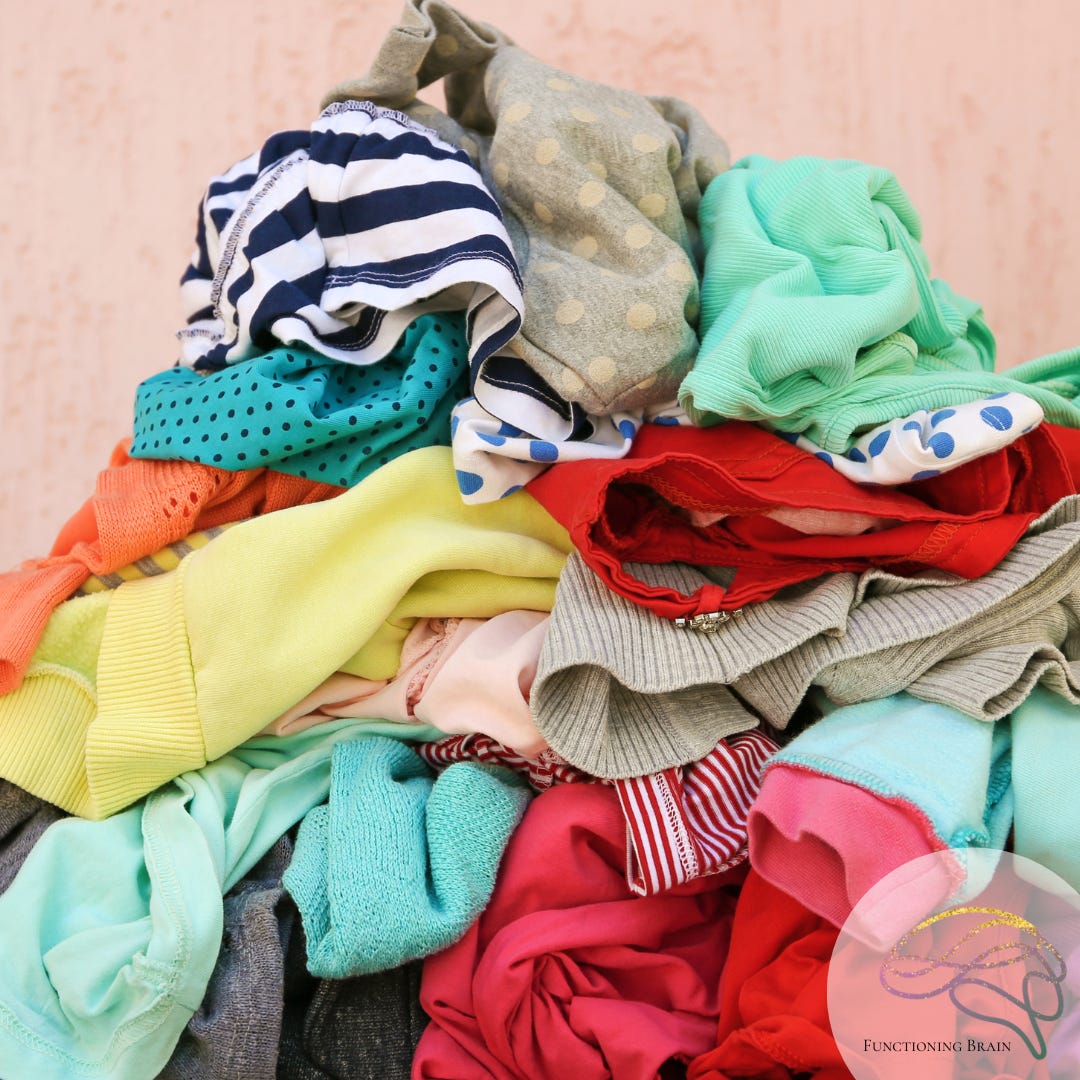
“Clean up.”
Two words that seem so simple—and yet, for kids (and adults) who struggle with executive functioning, those words can spark instant panic.
Why? Because cleaning up isn’t just about picking things off the floor. It’s actually one executive functioning-heavy task we regularly ask our kids to do. It requires sorting, decision-making, memory, flexibility, and inhibition—all at once. For some brains, that feels like juggling while riding a unicycle… uphill.
Let’s discuss why cleaning up is so complex—and why “just put it away” isn’t nearly as straightforward as it sounds.
Step One: Chunking Into Families
The first hidden demand of cleaning up is sorting things into categories, or “families.”
Take your spice cabinet as an example.
You pull out salt, pepper, oregano, paprika, garlic powder… your brain has to decide: these are all spices. That means they belong together as a family.
That single step relies on multiple executive functioning skills:
Attention: noticing which items are even part of the “spice” category.
Categorization: mentally grouping them together, not with mugs or forks.
Flexibility: handling the oddballs (is garlic salt a spice, or does it belong with salt?).
Working memory: holding the “family” in mind as you scan the room for more members.
For a neurotypical brain, this feels automatic. For a child still developing these skills, it can feel like being asked to solve a brand-new puzzle every time.
Step Two: Choosing a Home
Once you’ve grouped your spices, the next demand is selecting a place for them to live.
Most people have a spice drawer or cabinet. That decision is easy—spices go here.
But notice what just happened: now you’ve placed these items out of sight.
For many neurotypical people, that equals peace. Out of sight = clean space. The counters look clear, the kitchen looks “done.”
But here’s the executive functioning kicker: if you’ve tucked your spices out of sight, your brain has to remember:
That you own those spices in the first place.
Which cabinet or drawer you chose.
The specific spot within that cabinet.
That means tapping into:
Working memory (recalling where you stored things).
Retrieval (pulling it back when you need it).
Organization of space (placing it in a system that makes sense).
Now imagine you also experience aphantasia—a reduced or absent ability to create mental pictures. Suddenly, “spice drawer” is not a visual map in your mind. It’s a blank. You’re depending on sheer memory alone.
Step Three: Multiply by Hundreds
Now, repeat this process. Not just for spices, but for:
Silverware vs cooking utensils
Mugs vs cups
Pots vs lids
Tupperware vs water bottles
Straws, tea bags, snacks, baking pans, dish towels, oven mitts
Each category is another executive functioning workout.
Finally, your kitchen looks clean. The counters are clear. Everything is tucked away.
But here’s the question: can you depend on your brain to remember where everything is?
If you struggle with executive functioning, probably not.
And what happens when you’re in the middle of a high-demand moment—say, cooking dinner for guests—and you need the garlic powder right now?
Your working memory is already maxed out by the recipe, the hot pan, the timer on the oven. Suddenly, retrieving the spice feels like walking into a stranger’s kitchen and hunting for it from scratch.
Every. Single. Day.
Why Kids Leave Things Out
This is one of the reasons many kids who struggle with executive functioning leave everything out in the open… all over the place.
To us, it looks messy. To them, it looks safe. It’s visible. They can see what they need, when they need it, without relying on fragile working memory or invisible categories.
And here’s where the gap grows: we see a mess and think, Wouldn’t it be easier if you just put it all away?
But for their brain, “putting it away” often equals “losing it.” Out of sight, out of mind is not laziness. It’s a real executive functioning barrier.
The Solution: Visible Organization
So what do we do?
The goal isn’t to give up on organization—it’s to organize visibly.
That might mean systems that keep order and keep things in sight.
Kids can then find what they need without taxing an already-overloaded executive functioning system.
It won’t look like a Pinterest-perfect kitchen—or a spotless bedroom. But it will look like a space their brain can actually work in.
And that’s the real win.
The inability to clean up isn’t a character flaw or a matter of weak willpower. It’s a demanding executive functioning task we ask of our kids.
When we break it down, build visible systems, and celebrate progress (even if it’s socks moving from floor to desk), we’re not just making their space cleaner—we’re making their world more navigable.
And little by little, that scaffolding helps them build skills that will carry into every corner of life.
Warmly,
Tara Roehl, MS, CCC-SLP 💛
P.S. Paid subscribers—Tomorrow’s Tuesday Tips will be all about organizing visibly—with practical strategies you can try right away. We’ll look at how to create new systems with your child, so you both feel less anxious: you about the mess, and them about their things “disappearing.” Small shifts can bring big relief—and even turn organizing into a team effort instead of a battle. 💛